


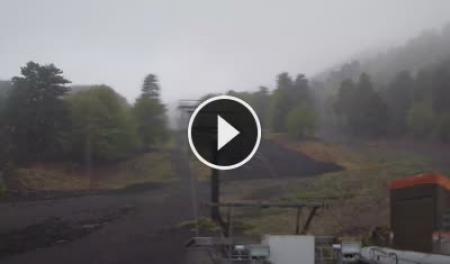
To find out whether there is snow on Etna, make three separate checks: a webcam with a visible timestamp, the forecast at the altitude you plan to reach, and confirmation that the road or service you intend to use is operating. Seeing a white summit from Catania does not mean it is snowing at that moment, the road is snow-covered, or lifts and tours are open.
A quick check: snow, roads and activities are three separate questions
| Question | Most useful source | Mistake to avoid |
|---|---|---|
| Is there snow on the ground? | A webcam for the correct side and elevation | Looking at only one image of the summit |
| Is it snowing now? | High-altitude radar/forecast and a timestamped image | Mistaking snow on the ground for ongoing snowfall |
| Is the road open? | Local notices and road-condition updates | Inferring it from a webcam |
| Are the cable car or other lifts operating? | A direct update from the operator | Assuming snow means they are open |
| Will the tour go ahead? | Confirmation from the operator | Turning up without reading messages or email |
How to read Etna webcams properly
Check which side is in view, the elevation, and the date and time. INGV images may show time in UTC, while Italian local time changes with daylight saving time. A wet lens, fog or an out-of-service webcam can make the volcano appear obscured or invisible.
Compare at least two viewpoints: Etna North may be snow-covered while Etna South is more exposed to the sun, or vice versa. When visible, look at car parks and roads too, but treat the image only as an indication.
When it usually snows on Etna
Snow is more likely from late autumn to early spring, especially above 1,800–2,000 metres, but there is no guaranteed calendar. Early or late snowfall is possible, and mild periods can quickly melt snow on sunny slopes.
Elevation and exposure change everything. You may find dry tarmac in Linguaglossa, snow at Piano Provenzana, and wind with poor visibility higher up. A forecast for the town therefore does not describe trekking conditions.
How to compare coastal and high-altitude weather
Find a forecast for the altitude and time of your route, not simply the nearest town. Temperature, mean wind speed, gusts, precipitation and the freezing level are distinct measures: a temperature above zero in Catania can coexist with snow and ice above 2,000 metres. The feels-like temperature also falls rapidly as the wind strengthens.
Follow the forecast hour by hour rather than stopping at a sunny icon. A clear spell in the morning may be followed by fog or wind in the afternoon. If the forecast is uncertain, take more protective clothing and ask the operator which elevation or alternative route may be used.
Snow does not mean ski runs and lifts are open
Opening a lift requires adequate snow depth and quality, safety, maintenance, staff, and suitable weather. The same applies to the Etna Cable Car, 4×4 vehicles, snowcats and guided activities. Check with the specific operator on the day of your visit.
Getting to Etna North or South in snowy conditions
The roads to Piano Provenzana and Rifugio Sapienza climb to high altitude and may be icy even after snowfall has stopped. Check whether chains or winter tyres are compulsory, bring chains correctly sized for your vehicle and learn how to fit them before setting off. Do not drive beyond closures or park on narrowed carriageways.
If you lack experience of driving in snow, choose a transfer or postpone the trip. A four-wheel-drive vehicle can help, but it does not replace suitable tyres, a safe following distance or caution on descents.
What happens to Dream Island excursions in winter
The programme is adapted to snow, ice, wind and accessibility. A summer trail may require different equipment or be replaced. Confirmation from the operator for your chosen date matters more than the general description.
Half-day Etna trekking
A first introduction to Etna North, including the Sartorius Craters and a cave.
€60
Etna North summit craters
A high-altitude excursion subject to the day’s conditions and access restrictions.
€120
Valle del Bove and Serracozzo Cave
A roughly 6 km hike with 500 m of elevation gain: some walking experience is needed.
€100
- The easy half-day tour may be adapted to an accessible itinerary while preserving the nature-focused Etna North experience.
- The high-altitude summit-crater excursion is the most sensitive to wind, snow and access restrictions; its altitude and route must not be considered guaranteed.
- Serracozzo and Valle del Bove require terrain and conditions suitable for a 6 km hiking excursion with 500 m of elevation gain.
What to wear to see snow on Etna
- A breathable thermal base layer, fleece, and a waterproof, windproof jacket.
- Warm, water-resistant trousers; avoid jeans, which become cold and heavy when wet.
- Hiking boots with appropriate tread, technical socks, and a dry change of clothes.
- Gloves, a warm hat, sunglasses and sunscreen: snow glare is intense.
- Water, snacks and a fully charged phone battery.
- Microspikes or snowshoes only if they suit the route and are recommended by the operator.
Final check on the morning of your visit
Check webcams and the forecast, verify the road, then contact the service provider or tour operator. If any one of these checks is missing, do not assume that the programme is confirmed.
Frequently asked questions about snow on Etna
Is there snow on Etna all winter?
No. The amount of snow and how long it lasts depend on elevation, temperature, wind and further snowfall.
If the webcam shows snow, can I ski?
No. Check the actual opening status of slopes, lifts and services with the operator.
Can I drive up without chains?
It depends on the road, your vehicle and any official orders. Carry the required equipment and check road conditions before you start the climb.
Do tours get cancelled when it snows?
Not automatically. Depending on safety and access, they may be confirmed, adapted, rescheduled or cancelled.
Which side of Etna gets the most snow?
There is no reliable rule for every day. Wind and exposure redistribute snow, so compare webcams for the northern and southern sides.
Webcams and sources to check
Use up-to-date sources and always check the timestamp: